

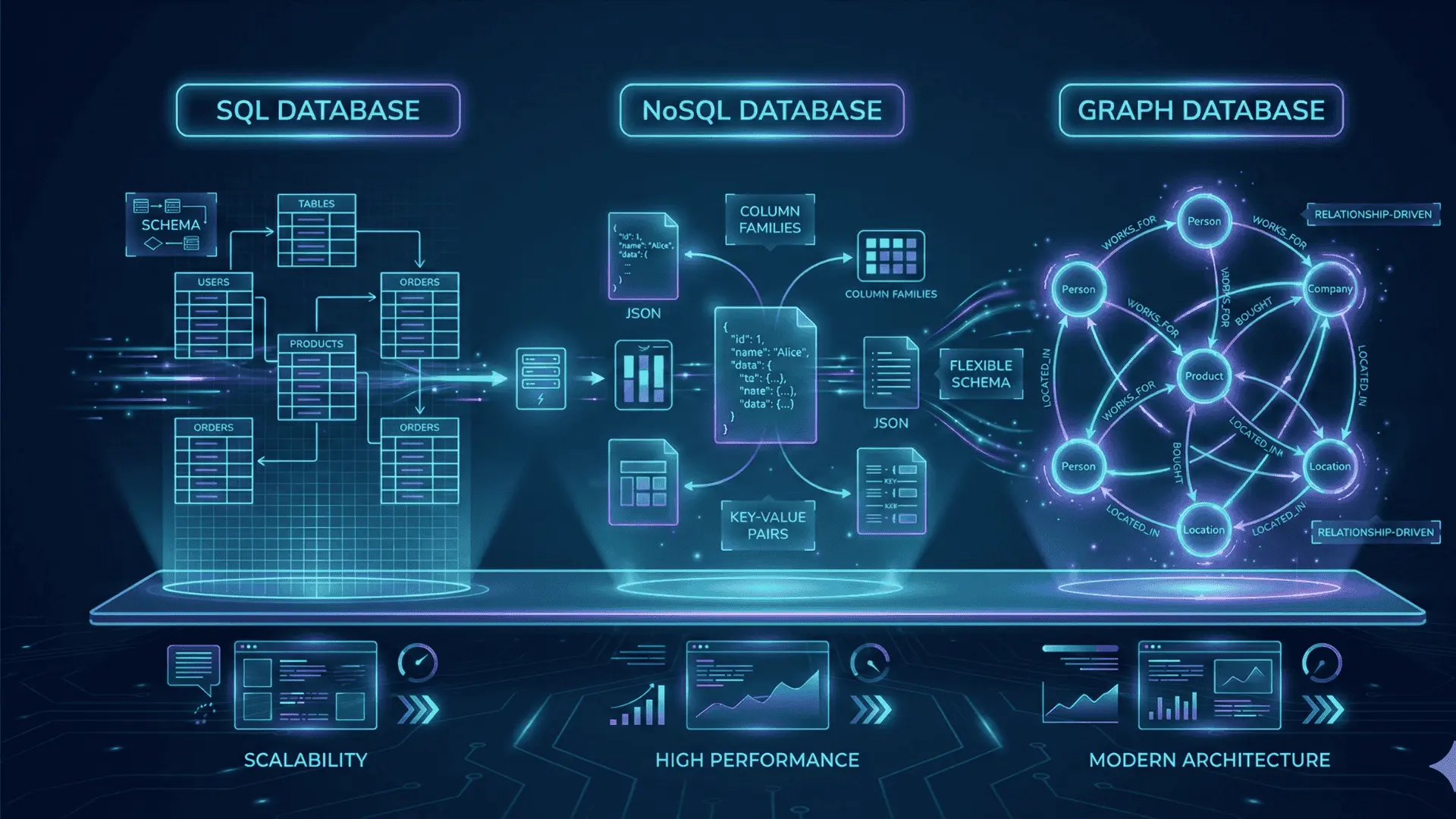
Selecting an appropriate database can be cover vital data architecture and crucial development decisions. Differentiating SQL, NoSQL and Graph databases helps build systems that are maintainable and scalable and can alleviate almost limitless hours of debugging and refactoring. This comparison provides a succinct overview of the three database paradigms to eliminate assumptions of which one to use on a given use case.
Understanding SQL Databases
SQL databases are one of the oldest and most enduring data management systems. They store structured data in related tables organized by a defined schema. Prominent examples include PostgreSQL, MySQL, Oracle, and SQL Server.
Advantages:
- Data Integrity (ACID): Adheres to ACID principles (Atomicity, Consistency, Isolation, Durability), ensuring reliable data — important for financial and e‑commerce systems.
- Performance & Querying: Can access large volumes of data efficiently with highly optimized queries for joins, aggregations, and analytics.
- Standardization: Standardized SQL language is widely adopted and relatively easy to learn.
- Robust Security: Built‑in authentication, encryption, and fine‑grained access controls.
Disadvantages:
- Rigid Schema: Inflexible structure makes schema changes time‑consuming and costly, which is unfavorable for rapidly evolving applications.
- Horizontal Scaling Difficulty: Scaling horizontally (adding more servers) is hard and resource‑intensive.
- Vertical Scaling Limits: Vertical scaling (upsizing hardware) is costly and eventually hits physical constraints.
- Cost: Commercial SQL database editions can be prohibitively expensive for smaller organizations.
Exploring NoSQL Databases
The term NoSQL (Not Only SQL) databases is intended to target the short comings relational database systems. NoSQL systems provide flexible and scalable data management systems that are deployed to distributed systems. NoSQL is a type of database is an umbrella term that includes several different databases.
Types of NoSQL Databases
- Document-Oriented Databases: An example of such a database is MongoDB, CouchDB. Store data either in BSON or JSON. It is best applied to semi-structured data, documents with various fields, varying attributes and easily add new ones, without the necessity of restructuring the whole system.
- Key-Value Stores: Redis, DynamoDB. The simplest form of NoSQL that involves storage of information in key-value pairs. Most effective in very fast lookups as well as quick reads and writes with very low latency.
- Column-Oriented Databases: e.g. Cassandra, HBase. Most appropriate in large data and analytics. Storages that store data in form of columns rather than rows. The queries are designed to use analytical types of queries and large data volumes.
- Graph-Based Databases: Represent information in forms of nodes and edges, which are used to represent information with complex interconnections.
Advantages:
- Scalability & Flexibility: Designed to scale horizontally across multiple servers, perfect for rapid growth. The flexible schema allows for quick iteration without costly database migrations.
- Handles Unstructured Data: Shines when handling unstructured or semi-structured data that doesn't fit neatly into predefined tables.
- Cost-Effective: Many NoSQL databases are open-source and cost-effective, making them attractive for startups.
Disadvantages:
- Consistency (BASE Model): Most follow the BASE model (Basically Available, Soft state, Eventually consistent) rather than ACID. Data might not be immediately consistent across all nodes.
- Lack of Standardization: Each type has its own query language and approach, requiring developers to learn different technologies.
- Relationship Management: Relationships between data are not inherently managed, which can lead to data duplication and increased application-level complexity.
Graph Databases
Graph databases offer a new way to understand relationships within data. Instead of saving data within tables or documents, data is structured as nodes (entities) and edges (relationships). Some of the more known graph databases are Neo4j and Amazon Neptune.
Why Are Graph Databases Differentiated?
Graph databases capture and analyze data situations where the relationships within the data are as important as the data itself. Take a social network for example: in a SQL database, as a user, to retrieve all of their friends, the database would have to perform multiple 'joins' and would require high-resource computing. In a graph database, the edges labeled as a ‘friend’ connected to a user node would provide a direct path to the user’s friends, and the computation would take milliseconds, regardless of the number of relationships.
Efficiency of Graph Databases
The speed of query execution in graph databases is their primary advantage. In a SQL database, a complex query scattered across various tables involving relationships would take a long time to perform. In a graph database, the same query would take milliseconds. Graph databases offer a great level of schema design. Nodes and relationships can gain new properties without the need of schema migrations, saving time and money. The data model naturally reflects real-world relationships, making the database structure more intuitive and easier to understand.
Making Your Choice
Selecting the right database depends entirely on your specific requirements:
- SQL should be selected when strong consistency, complex queries and structured data are required as well as compliance with ACID. It is perfect in financial systems, ERPs, and applications that have clear data structure.
- Use NoSQL when you have large amounts of unstructured data, or when you require a large scale and or when you need to quickly prototype your data model. It fits well in real- time analytics, IoT platforms and user-generated content platforms.
- Select Graph when your application is relationship intensive. Graph databases are useful in social networks, recommendation systems, among others, and fraud detection systems due to their relationship oriented approach.
Conclusion
A blanket database answer is impossible. Each type of database technology SQL, NoSQL, and Graph databases has unique benefits that address unique challenges. Many current applications integrate various database technologies, what is referred to as polyglot persistence. Gaining an understanding of the basics and the defining trade-offs of each technology enables the optimization of an application’s performance, scalability, and maintainability. Most importantly, the database technology should be fit to the specific characteristics of the data, as well as the access patterns.